
Tryptophan
The problem we have where tryptophan is concerned is that the science that has been done all suffers from a simple fundamental flaw in that it makes the assumption that calming and sedation are the same thing. That means the tests that have been developed actually test sedation. As tryptophan doesn’t sedate (which is a good thing) it will always fail these experiments.
Some of the papers referred to in this post use the “Reaction Speed Test”. That measures the instantaneous flight response to a scare over a distance of just two metres (about half a second). In those tests “control” (untreated) animals canter away at about 5 metres per second. Sedated horses trot away at about 3.5 metres per second. Give horses sedative drugs like Acepromazine (ACP, ACE, Sedalin) and they trot away. Magnesium, in small doses, also slows the reaction response down to a trot, which is to be expected as its sedative effects are well understood by the biochemists and neuroscientists – though many equine nutritionists argue against this.
Sedatives impair brain function. They are drugs that force the body to do something unnatural when they are used. In my view, good nutrition does not work that way. Good nutrition should enable the body to work normally not to force it to do something unnatural. That is why we like tryptophan.
To understand this we have to consider the role of serotonin. Serotonin is important in this discussion because it is made from tryptophan. Serotonin has two major and completely different jobs in the body:
1) Inside the brain serotonin is used as a neurotransmitter. That is a chemical message sent from one nerve cell to another. It is only used in a relatively small part of the brain and that is involved in our and our horse’s sense of wellbeing and relaxation.
If there is enough tryptophan to make serotonin, this part of the brain will function normally and the horse will have this ability to remain calm. This is about 10% of the serotonin in the body.
2) 80-90% of the serotonin in the body is actually used in the gut. When an animal is stressed it produces serotonin and that tells the gut muscles to contract, empty the gut, make the animal lighter and so facilitate flight or fight. Many of us have witnessed this effect on our horses, whether it’s putting their travel boots on to get into the trailer/lorry, or introducing them to a new environment:
This understanding gives a simple explanation of how a horse’s tryptophan reserves may be depleted – STRESS.
So stressed horses may become tryptophan deficient. And tryptophan deficient horses will benefit from tryptophan supplementation. Hence the ONLY horses that will benefit from tryptophan will be those that stress a lot.
Unfortunately for us, the ‘scientific’ research into the benefits of tryptophan does appear to be flawed, notably for the following reasons:
- Pre-stressed horses did not appear to be used. In fact many of the animals used were tested within their home environment, thus eliminating an element of stress from the experimentation.
- Additional sedatives were not removed from their diet in the lead up to the experiments – most notably Magnesium. For more information on the effects of Magnesium in a horse’s diet, read our extensive Magnesium section.
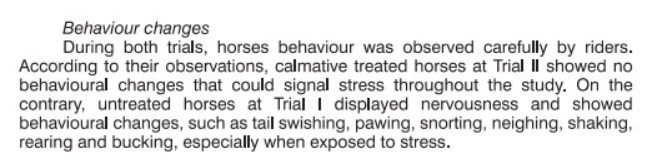
So having rather trashed most of the science I should point out that there is one paper that doesn't make this mistake. Instead it uses stressed horses (working police horses) and compares their behaviour (and a zillion physiological factors) when pre-supplemented with tryptophan (only about 2 grams) compared to unsupplemented.
Their conclusion is clear the untreated horses (Trial 1) got very stressed at work. The treated horses (Trial 2) didn't.
You will find this at:
Influence of a calmative on Selected Blood Parameters in Horses Under Stressful Conditions, Nemec Svete Alenka et al, Acta Veterinaria (Beograd), 2008.
In our experience Tryptophan either helps or it doesn’t there isn’t much of a grey area. It will work in the situations described above but only if other nutritional issues are not impacting negatively on behaviour. This is why we nearly always work to get chelated calcium and magnesium right before using tryptophan to fix specific, stress related issues.
When we first investigated tryptophan we were aware of the claims that it could affect stamina. So we gave a gram or two very carefully. Then one of our sponsored riders gave a 4* event horse (with a history of stress in big dressage arenas) 40 grams! The horse completed all three phases perfectly – no stamina issues on XC at all. Since then we have often started horses on 10g or 20g and never had any stamina issue reported in any horse (including endurance horses).
As horses gain in confidence their need for tryptophan diminishes. The horse mentioned above ended the season on just 3 grams a day and later dropped to no tryptophan at all at which level it qualified for a senior British team.
The eventing anecdote quoted above took place in 2011. We have been selling tryptophan since then and, based on customer feedback, refined the advice we give and the circumstances in which we use it. In the right circumstances it is a really powerful nutritional tool with no downsides that we have identified in normal use.
You can buy Tryptophan as our product FineTUNE 3. It is third on our fine tune list primarily because it doesn't taste very nice and we seem to need more of it than Tyrosine.
Tryptophan is also built into CCC Bombproofing and CoolCORE Bombproofing.
Tryosine

Tyrosine is an amino acid that is beginning find a role in horse calming supplements. Unfortunately a number of the other amino acids used in calmers also begin with “T” creating a huge potential for confusion – especially as some of them work in particularly different ways.
Tyrosine is incorporated into many proteins and itself can be made in the body from phenylalanine. Animals can’t make phenylalanine so if they are not eating enough of that they can run out of tyrosine impacting on the ability to make proteins.
Tyrosine is also used to make a number of hormones and neurotransmitters. These include dopamine, epinephrine (also known as adrenaline) and norepinephrine. It is the broader biologically active chemicals – or the lack of them - that impact most on horse behaviour. When stressed horses produce more of these hormones that can deplete tyrosine (and tryptophan) levels. A shortage of those two amino acids seems to lead to insufficient levels in the brain and that is what causes the behavioural issues.
Supplementing with tyrosine does not seem to force the production of any of these hormones - so it has no effect if the levels have not been depleted (see below). So it meets our (EquiFeast’s) requirement of being an “enabler” not a drug. At EquiFeast we are passionate that our job is to help horse’s brains to function properly not to force them to be sedated. Having said that the combination of very low levels of tyrosine with high magnesium diets doesn’t seem to be ideal. So we do have a minimum application rate for tyrosine.
This showed up in the trials we ran on tyrosine early in 2019. The outcomes of those trials were roughly:
- 10% negative effect (with high Mg diets)
- 30% no effect
- 60% helped horses with improved behaviour
So, just as with any other calmer, it isn’t always the whole answer. During the first year of incorporating tyrosine into our chelated calcium products we have definitely had fewer fine tuning needs. So tyrosine has been an overwhelmingly successful improvement to our formulations. But we have found five horses (a miniscule percentage) that respond poorly to it - even with no added magnesium in the diet. These five ALL had what we might call hormone diseases. So while not all horses that have these problems respond badly to tyrosine it seems that all of the horses that do respond badly to tyrosine have one of these problems. We can't find any reference to this in the literature or any mentions from other supplement companies using tyrosine but if you Google "diabetes" and tyrosine you get some questions raised over human situations.
LamiCORE and LAM Essentials are therefore formulated without tyrosine.
The really good news about tyrosine is that we seem to be able to use much smaller amounts than we have of Tryptophan in the past. It is also much more palatable than tryptophan. So tryptophan has been demoted in our fine tuning process and may become less important over time.
The other two amino acids beginning with “T” that are commonly used in calmers are Theanine and Taurine. We do not use either as both interfere with normal brain function by locking on to the same receptors in the brain as diazepam. This makes them non-compliant with FEI regulations as well as being a method of calming horses that we are not comfortable with.
EquiFeast products that contain Tyrosine.
Any of our CORE range of balancers except for LamiCORE
Any of our Cool, Calm and Collected range of supplements
Sensible Essential
Any of our WINNINGEDGE Supplements
Chelated calcium products that do not contain Tyrosine:
LamiCORE Starter and LamiCORE Follow On are only available tyrosine free as are LAM Essentials and LAM Essentials Starter
Related articles:
Would you like us to take a look at your whole diet? Since we started diet reviews and encouraging customers and new recruits to stop using feeds with magnesium or GABA agonist herbs in them our success rates and retention rates have improved dramatically.
https://equifeast-shop.com/free-diet-review/
For more information on how your horse’s diet can affect their behaviour, please speak to one of our advisers on: 01453 836974 or email us on advice@equifeast.com